Marketing is not just about promoting a product. It is about delivering the right product to the right people at the right time and price. One of the most important concepts that helps businesses achieve this is the Marketing Mix.
The marketing mix is a strategic framework used by companies to plan and execute their marketing strategies effectively. It helps businesses design products, set pricing strategies, choose distribution channels, and communicate with customers.
In this guide, you will learn the meaning of marketing mix, definition, components of the 4Ps and 7Ps, examples, importance, and how it works in modern digital marketing.
What is Marketing Mix?
The marketing mix refers to a set of tools or strategies that businesses use to promote their products or services in the market.
In simple terms, the marketing mix is the combination of factors that a company controls to influence customers and achieve its marketing objectives.
These factors help businesses answer key questions such as:
- What product should we offer?
- What price should we charge?
- Where should we sell the product?
- How should we promote it?
The marketing mix ensures that all marketing activities work together to satisfy customer needs and achieve business goals.
Definition of Marketing Mix
The concept of the marketing mix was introduced by Neil Borden in the 1950s and later simplified into the 4Ps of Marketing by E. Jerome McCarthy.
Marketing Mix Definition:
The marketing mix is a combination of marketing elements that a company uses to promote its products or services and satisfy customer needs.
These elements help businesses create the right marketing strategy to compete in the market.
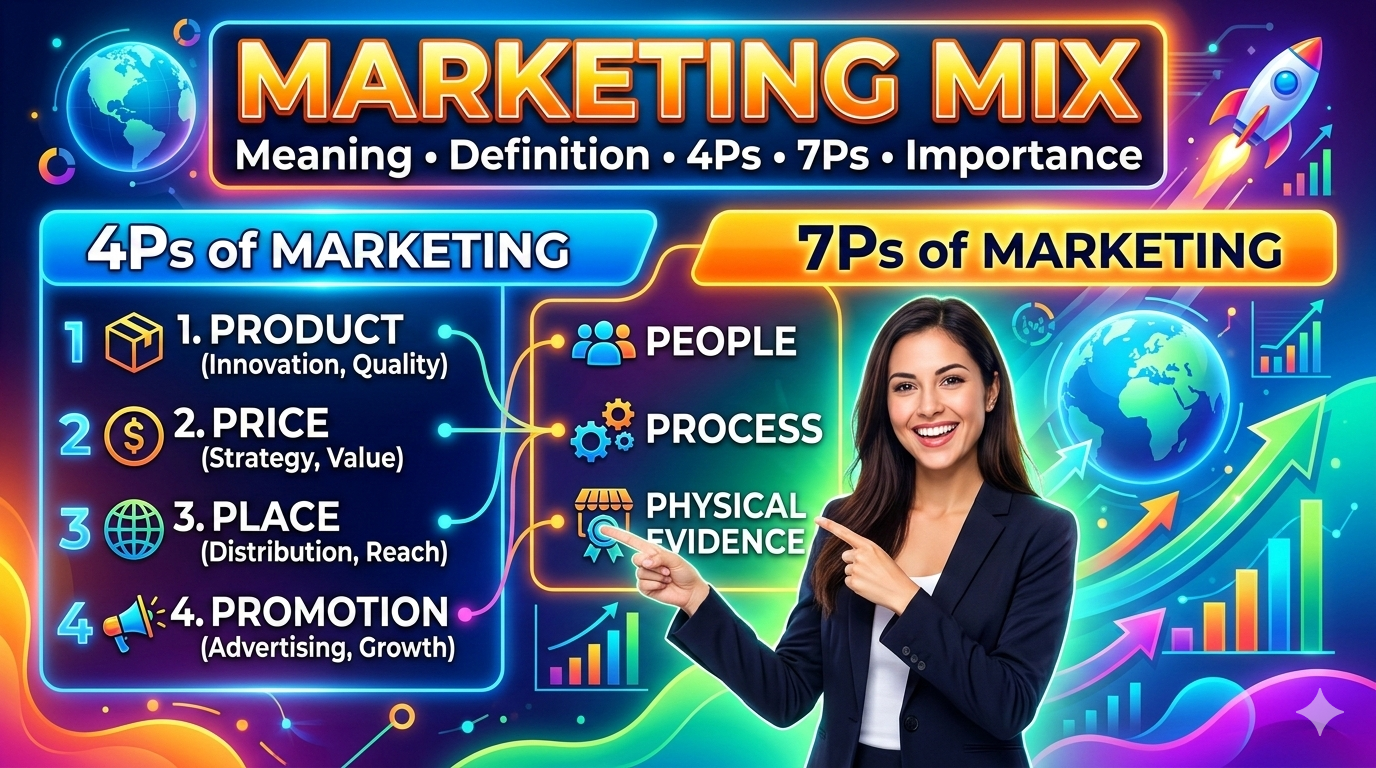
The 4Ps of Marketing Mix
The traditional marketing mix consists of four key elements known as the 4Ps.
1. Product
The product is the item or service that a company offers to customers to satisfy their needs or solve their problems.
A product can be physical goods like smartphones or services like online education.
Key product decisions include:
- Product design
- Quality
- Features
- Branding
- Packaging
- Product lifecycle
Example:
Apple focuses heavily on product innovation, design, and user experience when launching new iPhones.
SEO Keywords:
product strategy, product marketing, product development
2. Price
Price refers to the amount customers pay to purchase a product or service.
Pricing strategies influence customer perception and company profitability.
Common pricing strategies include:
- Competitive pricing
- Penetration pricing
- Premium pricing
- Discount pricing
- Psychological pricing
Example:
Luxury brands use premium pricing strategies to position their products as high-value and exclusive.
SEO Keywords:
pricing strategy, product pricing, value-based pricing
3. Place
Place refers to how and where a product is distributed and made available to customers.
It focuses on distribution channels and logistics.
Distribution methods include:
- Retail stores
- Online marketplaces
- Direct selling
- E-commerce websites
- Wholesale distribution
Example:
Amazon uses a strong logistics and distribution network to deliver products quickly worldwide.
SEO Keywords:
distribution strategy, marketing channels, supply chain marketing
4. Promotion
Promotion involves the communication strategies used to inform and persuade customers about a product.
Promotion helps build brand awareness and influence purchasing decisions.
Common promotional tools include:
- Advertising
- Social media marketing
- Content marketing
- Influencer marketing
- Public relations
- Email marketing
- Search engine marketing
Example:
Brands use Instagram reels, YouTube ads, and influencer collaborations to promote their products online.
SEO Keywords:
promotion strategy, digital marketing, advertising strategy
The Extended Marketing Mix (7Ps)
With the growth of service industries, marketers expanded the marketing mix from 4Ps to 7Ps.
The additional elements include:
5. People
People refer to employees, customer service teams, and anyone involved in delivering the service.
Good customer service improves customer satisfaction and brand reputation.
Example:
Hotels focus heavily on staff training to enhance customer experience.
SEO Keywords:
customer experience, service marketing, customer service strategy
6. Process
Process refers to the systems and procedures used to deliver products or services efficiently.
Efficient processes improve service quality and reduce costs.
Example:
Online food delivery apps use optimized order tracking systems to improve customer satisfaction.
SEO Keywords:
service delivery process, operational efficiency
7. Physical Evidence
Physical evidence refers to the tangible elements that support a brand experience.
Examples include:
- Store layout
- Website design
- Packaging
- Brand environment
Example:
Luxury stores create premium environments to reinforce their brand image.
SEO Keywords:
brand experience, service environment, brand identity
Importance of Marketing Mix
The marketing mix is essential for building a successful marketing strategy.
1. Helps Understand Customer Needs
Businesses can design products that solve real customer problems.
2. Improves Marketing Strategy
It provides a structured approach to marketing planning.
3. Increases Competitive Advantage
Companies can differentiate themselves from competitors through pricing, branding, or distribution.
4. Supports Business Growth
A well-planned marketing mix increases sales, customer satisfaction, and brand loyalty.
Marketing Mix in Digital Marketing
In the digital era, the marketing mix also includes online strategies such as:
- Search engine optimization (SEO)
- Social media marketing
- Content marketing
- Email marketing
- Influencer marketing
- Performance marketing
Businesses now integrate the traditional marketing mix with digital channels to reach global audiences more effectively.
Example:
An online course platform may use:
- Product: Digital course
- Price: Subscription model
- Place: Website and mobile app
- Promotion: SEO, YouTube videos, and Instagram marketing
Example of Marketing Mix Strategy
Consider a fitness supplement brand.
Product: High-quality pre-workout supplement
Price: Competitive pricing for gym users
Place: Online store and fitness centers
Promotion: Instagram influencers and fitness ads
This combination creates a strong marketing strategy that targets fitness enthusiasts effectively.
Key Benefits of Using the Marketing Mix
- Better marketing planning
- Improved customer satisfaction
- Higher brand visibility
- Stronger brand positioning
- Increased sales and revenue
Businesses that effectively use the marketing mix can build long-term customer relationships and sustainable growth.
Conclusion
The marketing mix is one of the most fundamental concepts in marketing. It helps businesses combine the right product, price, place, and promotion to meet customer needs and achieve business objectives.
The traditional 4Ps of marketing provide a strong foundation, while the extended 7Ps model helps service industries deliver better customer experiences.
In today’s competitive market, companies must continuously adjust their marketing mix strategies to adapt to changing customer behavior and digital marketing trends.
A well-designed marketing mix not only improves brand visibility but also builds trust, increases customer satisfaction, and drives long-term business success.